
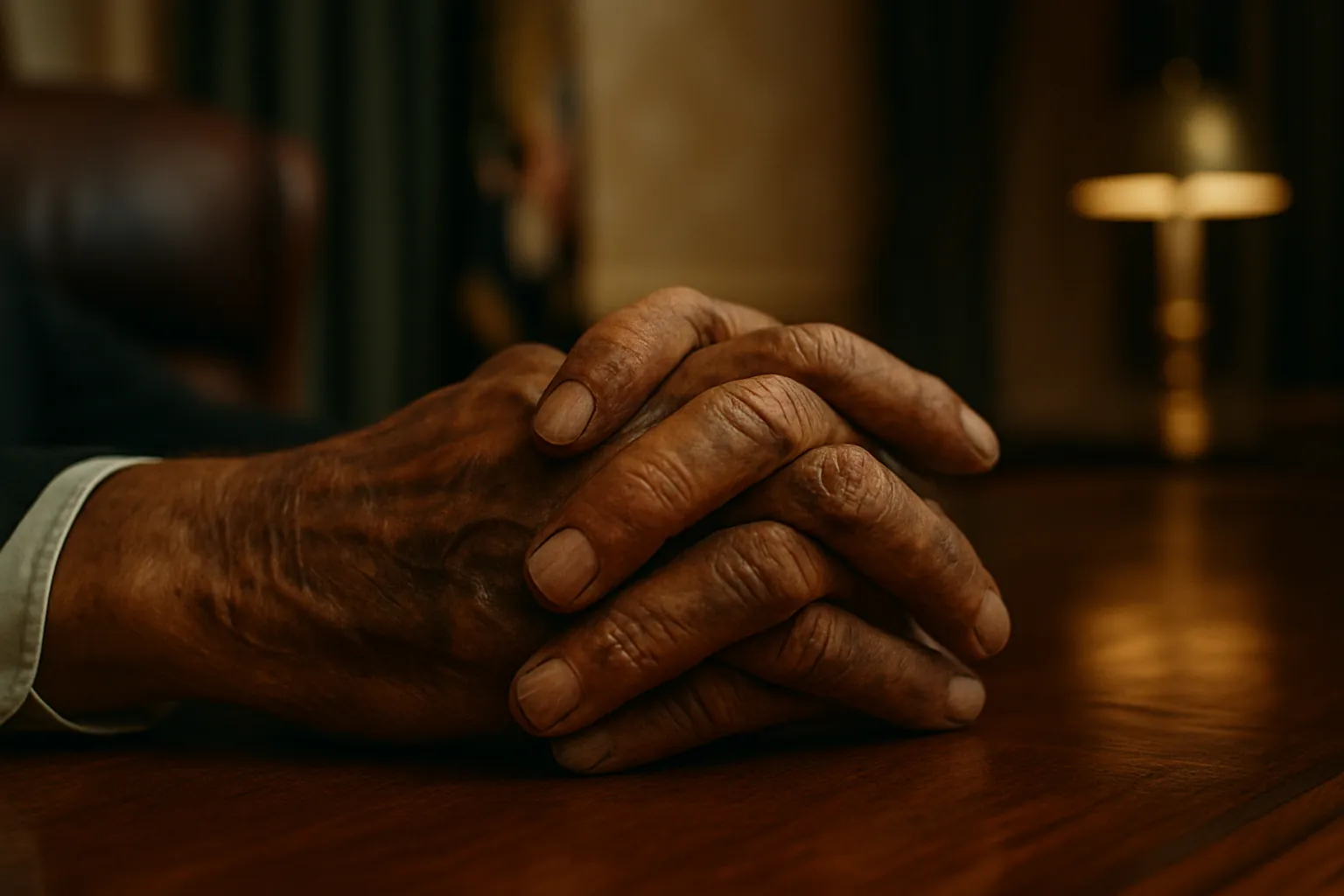
Spotlight on Hands, Not Policy: The Viral Photo That Sparked a Storm
In an era where the smallest details can set the internet ablaze, a single photo shared by Vice President JD Vance on X (formerly Twitter) ignited health speculation about President Donald Trump that outshined even the intent of the gathering: a friendly dinner between Trump, First Lady Melania, Vance, and his wife Usha. The group was all smiles, but the internet’s gaze immediately landed not on camaraderie or conversation, but on the distinctly bruised and discolored patch on Trump’s hand. It seemed the world had collectively squinted past the meal, past the famous faces, zeroing in on the president’s visible marks.
As the photo ricocheted across social platforms, commentary ranged from tongue-in-cheek jabs—“It’s almost Halloween!” quipped one user—to sincere unease. Others floated theories that the discoloration was cosmetic, possibly makeup intended to cover a bruise. Jokes briefly trended, but abated quickly as genuine concern flooded comment threads: Why, people asked, did Trump’s hands look as though he had recently suffered an injury?
White House Press Secretary Karoline Leavitt attempted to pour water on the flames, characterizing the marks as the product of a president “constantly working and shaking hands,” a “man of the people” narrative that sought to frame the bruises as badges of energetic leadership.
Medical Opinions and White House Spin: Scrutiny That Never Sleeps
The scrutiny directed at Trump’s physical health is neither new nor unique. American presidents have long been held captive to public fascination with their bodily well-being—a fixation that often outpaces genuine policy debates. As New York University historian Matthew Dallek notes, “The health of the president is treated, rightly or wrongly, as a national concern. That level of scrutiny is both a reflection of our anxieties and our expectations of presidential invincibility.”
Medical experts entered the fray with nuanced takes. Urologist Dr. Boback Berookhim, interviewed by several networks, emphasized that such discolorations are typical among older adults and often result from harmless causes: blood draws for routine screenings, a minor knock against a doorframe, medication monitoring, or simply the thinning skin that comes with age. Still, skepticism prevails because, as Dr. Neal Patel, a New York-based internist, points out, “Frequent handshaking alone is highly unlikely to produce such specific bruises unless underlying health conditions make the skin unusually fragile.”
The White House’s explanation—that the marks were the consequence of relentless public interaction—was met with both ridicule and disbelief. If you’re reminded of the Reagan era, you’re not alone. Recall how President Reagan’s health crises, initially downplayed as routine, eventually forced unprecedented transparency following his 1985 cancer surgery. History teaches us that the American public, while respectful of privacy, expects forthrightness—especially when the leader of the free world is involved.
“A man who is entrusted with nuclear codes owes his citizens honest answers—even about the bruises on his hand. The symbolism may be trivial, but the trust it touches is not.” — Dr. Neal Patel, internist
Beyond the medical analysis, the deeper issue is the perpetual tension between transparency and spin. When a sitting president—especially one as polarizing as Trump—shows any sign of frailty, the nation’s response is seldom measured. Progressive circles are keenly aware that this heightened scrutiny has not greeted every president in equal measure. Franklin D. Roosevelt’s disabled body was concealed from the public for years, while more recent leaders have had their annual physicals dissected in excruciating detail. The why of this selective scrutiny, especially on aging conservative leaders, remains itself a study in the politics of perception.
More Than Just a Mark: Health, Power, and Public Trust
The fascination over Trump’s bruised hand reflects more than idle curiosity—it’s a litmus test for the broader issue of accountability and trust between elected officials and the public. Is the hand just a hand, or the metaphorical canary in the coal mine for more profound questions about a leader’s capacity?
Conservative responses to the uproar have largely dismissed the discourse as superficial, a distraction crafted by “gotcha” liberal media. Yet this dodges a fundamental reality: Leaders who campaign as avatars of populist vigor invite scrutiny not just for their words, but for the vitality they promise. When the White House turns what may be a health concern into a tale of relentless work ethic, that spin risks eroding faith rather than building it. Harvard political scientist Zoe Marks underscores this: “By dismissing public curiosity as idle gossip, the administration misses an opportunity for authentic connection—a value progressives prize deeply.”
Real stories from everyday Americans surface beneath the noise. Take Mary Scalia, a retired nurse in Cleveland who has cared for elderly patients her whole career. “I’ve seen that kind of bruising on folks with thin skin or on certain medications. But when it’s the president, people want answers—because at that level, it’s not just a personal issue, it becomes a public one,” she told CNN. Her experience encapsulates a core progressive belief: health transparency from those in power strengthens democracy, not weakens it.
When leaders shroud the ordinary realities of aging and health in official narratives, they miss a chance to foster trust and normalize vulnerability. As the 2024 election nears, every photo, every word, every unexplained mark will take on outsized meaning. Progressives should demand honesty about the realities of age and health—not out of partisanship, but out of respect for a nation that deserves nothing less from its leaders. If the trust in our institutions is to survive, it will be built not by mythologizing figures as superhuman, but by embracing—even in something as small as a bruise—the humanity at the heart of democracy.
