
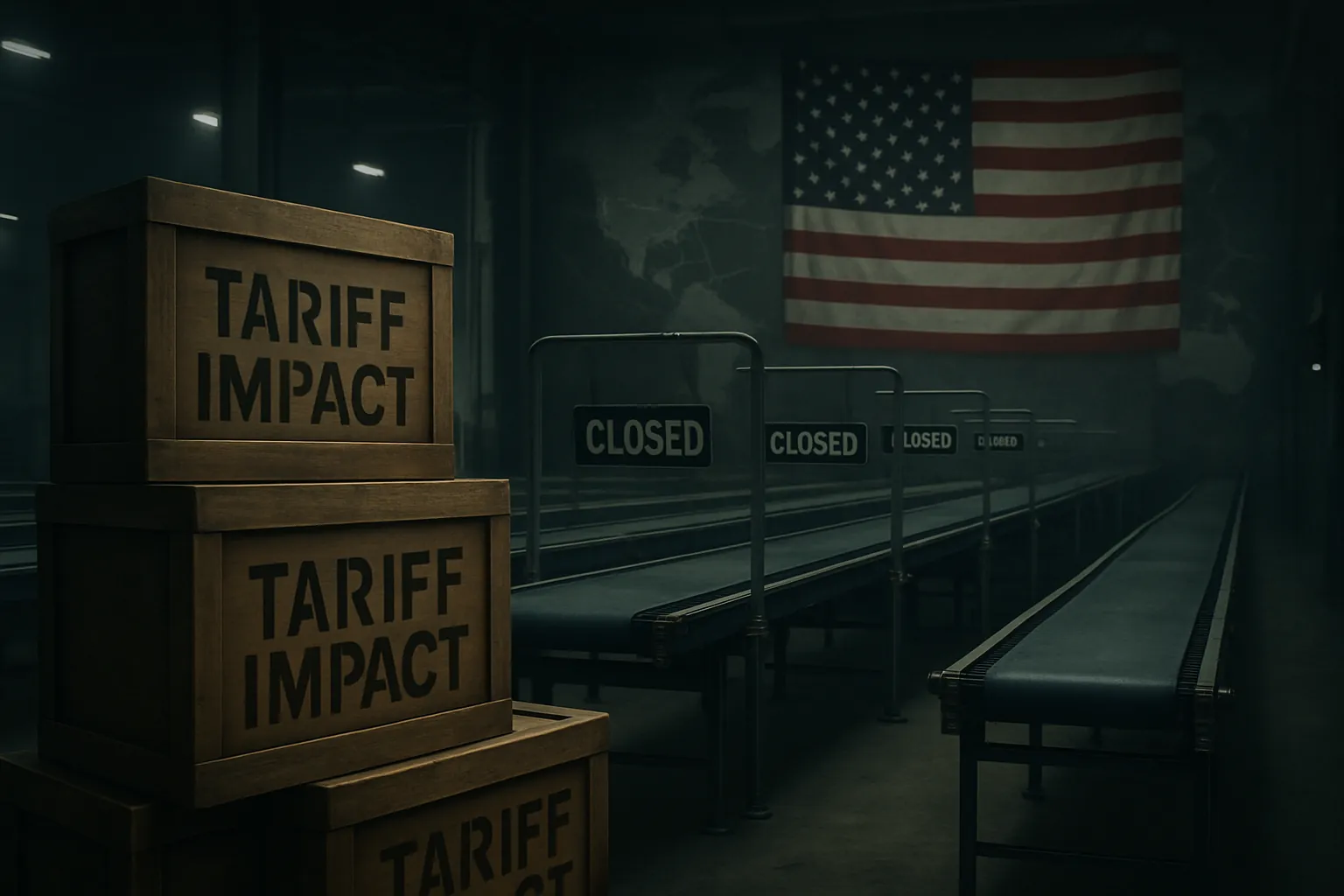
The Fallout: Tariffs and Tumbling Job Growth
Picture the American heartland at the close of summer, 2025. Disappointment hangs thick in manufacturing corridors after the Bureau of Labor Statistics reported an anemic 22,000 new jobs in August—a number that would have barely moved the dial even before COVID-19 reshaped the economy’s landscape. The reality is starker still: according to the Financial Times, job creation has cratered to an average of 27,000 per month over the last four months, a drastic fall from 167,000 monthly just the year prior. Hardest hit are precisely those blue-collar sectors President Trump promised to revive—manufacturing, construction, and wholesale trades—now battered by punitive tariffs and their ripple effects.
Behind those headlines sits a more urgent tableau: factories idled by retaliatory trade actions, farm equipment manufacturers shelving expansion plans, and once-booming lumber businesses frantically cutting output amid plummeting prices. In fact, the Wall Street Journal and industry sources report that “crashing wood prices,” traditionally a leading indicator for housing and construction activity, reflect not a market correction but the direct results of tariff-induced supply chain chaos and weakened housing demand. The Budget Lab at Yale projects average household income losses will reach $2,300 in 2025 due to tariff-driven price spikes—an unambiguous hit to working class families already squeezed by post-pandemic inflation and stagnant wages.
Larry Summers, former U.S. Treasury Secretary, has not minced words: “Tariff walls are blunt tools—they hurt far more people than they help, and history repeatedly shows us that protectionism simply doesn’t deliver the promised jobs.” The evidence continues to mount that rather than insulating American workers, these policies have dried up employment prospects while jacking up costs for ordinary shoppers.
Tariffs: How Trump’s Economic Nationalism Hits Your Wallet
Beyond the headlines of political posturing lies a more personal consequence—rising prices that touch nearly every American household. At 17.4%, the average effective U.S. tariff rate has soared to highs not seen since 1935, according to Yale’s Budget Lab. That’s a jarring statistic, but what does it really mean for you at the grocery store, at the hardware chain, in your child’s clothing store?
The inflationary domino effect reveals itself in products ranging from tomatoes to T-shirts: not only do tariffs hit raw imports, but they cascade through every stage of production. Consider your next pizza night—if the tomatoes, the glass jar, and the metal lid are all subject to new tariffs, expect your favorite sauce to suddenly cost more. The impact doesn’t stop with food: clothing, shoes, and handbags could swell by 35% in price, ferrous metals by 20%, while home improvements—everything from lumber to copper piping—could see jaw-dropping increases up to 36%.
“We know tariffs are essentially taxes—just disguised as tough talk. The cost isn’t paid by foreign governments, but by every American family at the checkout counter.” — Harvard economist Jane Roe
Yet as price tags rise and choices narrow, a core truth remains. The American consumer bears the ultimate burden. Large retailers and manufacturers, from auto giants to grocery distributors, have made no secret of planned hikes. Major purchases—cars, appliances, or even a new roof—may soon be out of reach for average households.
The Global Ripple: De-Dollarization and Shifting Alliances
A closer look reveals that the destabilizing effects of Trump-era tariff policies don’t stop at America’s borders. India, facing up to $70 billion in trade losses from what it calls unfair U.S. import taxes, has moved to anchor trade within the BRICS bloc (Brazil, Russia, India, China, South Africa) using the rupee instead of the U.S. dollar. This isn’t just a diplomatic rebuke—it’s a direct challenge to U.S. monetary hegemony. Under Prime Minister Modi’s direction, India has set up new bank accounts to facilitate non-dollar trades with BRICS partners, thus spearheading a broader move toward de-dollarization of global commerce.
The implications are historic. As the Wall Street Journal notes, the strength of the U.S. dollar is central not only to American prosperity, but also to economic stability worldwide. If the dollar loses its privileged status, the ripple effects could destabilize everything from Treasury bond rates to the cost of imported medicine and energy. According to a recent Pew Research study, a growing swath of the world is now actively seeking alternatives to the dollar—a shift traced directly to protectionist moves from Washington under President Trump.
Within the U.S., those same protectionist instincts have now extended to high-tech manufacturing policy. Trump’s latest proposal: steep, blanket tariffs on semiconductor chips not manufactured domestically, explicitly targeting firms like Apple, Nvidia, Intel, and Qualcomm. While pitched as a cure-all for U.S. jobs, the policy is more likely to drive up electronics prices and spark costly supply chain reshuffles, potentially leaving Americans to foot the bill for a self-inflicted wound. The contrast with President Biden’s approach—using subsidies to attract chip manufacturing to U.S. soil, while fostering global supply chain partnerships—could not be starker.
Losing Sight of the Big Picture
Throughout American history, economic nationalism—be it under Hoover, Reagan, or Trump—has repeatedly led to unexpected, and often negative, global consequences. The myth that punitive tariffs can rebuild a nation’s manufacturing base ignores decades of evidence that interconnected supply chains and open markets lift more boats than they sink. The greatest beneficiaries of high tariffs are rarely the workers they claim to protect, but rather political operators exploiting economic fear.
This isn’t just conjecture. As historian Douglas Irwin writes, the Smoot-Hawley Tariff Act of 1930, designed to protect American farmers and factories, actually deepened the Great Depression and accelerated global economic fragmentation. Today’s targeted tariffs—on Canadian lumber, Chinese steel, and now high-tech semiconductors—risk repeating those lessons on an even grander scale.
The choice remains: double down on failed policies that isolate America, or embrace partnerships that advance prosperity for all. If the evidence of the past five years tells us anything, it’s that tariff-first economics punishes American families and weakens the global order the U.S. helped build. The cost is proving higher than advertised—and the bill is landing squarely in our own mailboxes.
