
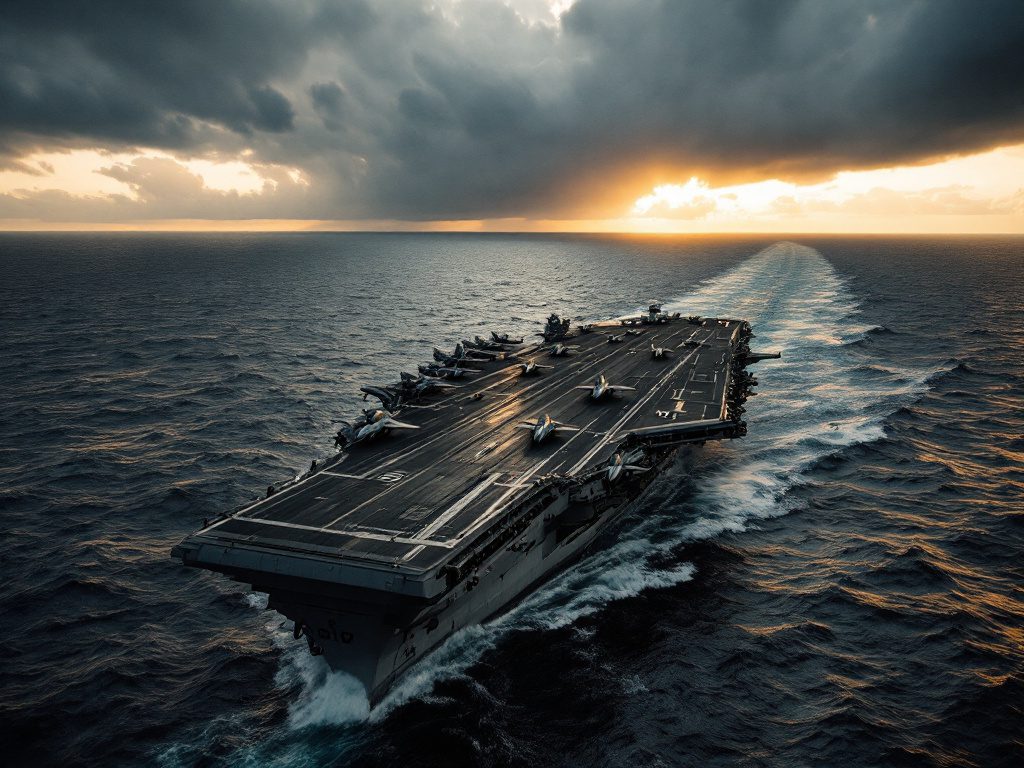
The arrival of a second U.S. aircraft carrier, the USS Carl Vinson, in the Middle East signals a significant escalation of American military power in a region already grappling with instability. Following on the heels of ongoing strikes against Yemen’s Houthi rebels and heated discussions regarding Iran’s nuclear program, the heightened deployment poses an urgent question: Is the U.S. edging towards direct confrontation with Iran?
Expanding American Military Presence
The USS Carl Vinson, a formidable Nimitz-class aircraft carrier featuring advanced F-35C Lightning II stealth fighters, now joins the USS Harry S. Truman, marking a rare concurrence of two significant naval assets in waters proximate to Iran and Yemen. According to U.S. Central Command (CENTCOM), this deployment is meticulously planned and echoes broader international security dynamics, notably in sectors of northeast Africa, the Middle East, and parts of Central and South Asia.
U.S. Defense Secretary Pete Hegseth has emphasized that the deployment aligns with American objectives aimed at regional stability and ensuring secure global commerce. The addition of the Carl Vinson underscores an American commitment to fortify navigational freedoms and commercial operations, particularly as threats to maritime routes like the Red Sea and Gulf of Aden proliferate.
But isn’t the simultaneous ordering of two powerhouse carriers into sensitive Middle Eastern hotspots more than a geopolitical statement? It certainly signals the gravity with which the U.S. views the turmoil currently shaping the regional chessboard. Whether prompted by prudent strategic foresight or preparations for potential military escalation remains critical to understanding America’s next moves.
Yemen Conflict and Regional Implications
Since mid-March, over 200 targeted airstrikes have been launched by the U.S. against Houthi infrastructure—marking a pronounced escalation in a conflict that has drawn in regional actors and global powers alike. The Pentagon’s strategy, evidently, involves amassing naval and aerial firepower sufficient to send a resolved message to the rebels and their Iranian backers: further threatening vital shipping lanes will trigger severe repercussions.
The Houthi rebellion, which opposes Yemen’s internationally recognized government supported by a Saudi-led coalition, has not been quiet in the face of heightened U.S. pressure. Houthi leaders publicly declared renewed retaliatory measures against both American and Israeli ships passing through key regional waterways like the Suez Canal—threats that further entangle an already convoluted international crisis.
A closer look at the regional dynamics reveals an emboldened Houthi movement declaring solidarity with Palestinians amid ongoing regional crises, notably the vicious conflict between Israel and Hamas in Gaza. These cross-conflict solidarities deepen the linkage between distinct yet increasingly interconnected skirmishes, complicating diplomatic avenues for peace and heightening threats for commercial shipping along vital maritime arteries, thus demanding a coherent international strategy.
“The deployment of multiple carrier strike groups is not just a symbolic show of force—it’s a deliberate signal that U.S. patience regarding threats to regional stability and vital commerce is wearing thin,” stated former CENTCOM advisor Ambassador Mark Wallace, highlighting the tactical gravity behind the Carl Vinson’s arrival.
The Looming Specter of Iranian Nuclear Ambitions
At the heart of America’s display of military resolve is the ominous specter of Iran’s nuclear ambitions. As the U.S. plans imminent negotiations with Tehran, the presence of two fully equipped aircraft carriers near Iranian waters unmistakably signals the U.S. administration’s unwillingness to tolerate a breakthrough in Iran’s nuclear capability.
Iran’s leaders, sensitive to military posturing near their shores, term such deployments provocative and dangerously escalatory. Historically, heightened tensions have often led to volatile outcomes between U.S. forces and Iranian naval and rocket units, highlighting how quickly cautious deterrence can spiral into misguided warfare.
Harvard political scientist Trita Parsi explains, “Deploying multiple carriers to contentious waters adjacent to Iranian territory risks inadvertently triggering the very escalation advocates claim they want to avoid, potentially plunging both nations into unnecessary conflict.”
The Biden administration faces a crucial decision in how it chooses to leverage these naval deployments, particularly with a wary American public mindful of Iraq War lessons. Deploying formidable military assets is a powerful lever of diplomacy—but without caution, it risks becoming a prelude to unwanted warfare.
As U.S. commanders reference emerging alliances between Russia, China, and North Korea, this heavy-handed naval posture appears part of broader American strategy responding to global military realignments. Yet, precisely mapping out how such deployments integrate into a clear, coherent regional or global security framework has proved challenging thus far.
For ordinary citizens and global businesses heavily reliant on uninterrupted maritime navigation, the stakes could not be higher. Missteps here don’t merely mean intensified conflict—they risk disrupting essential international commerce that affects global markets and livelihoods.
Engaging the military might of multiple aircraft carriers sends a coherent but risky signal to global and regional adversaries alike. The tough question demanding Washington’s attention right now is whether these deployments effectively deter adversaries or simply edge the world closer towards dangerous, unintended escalation.
