
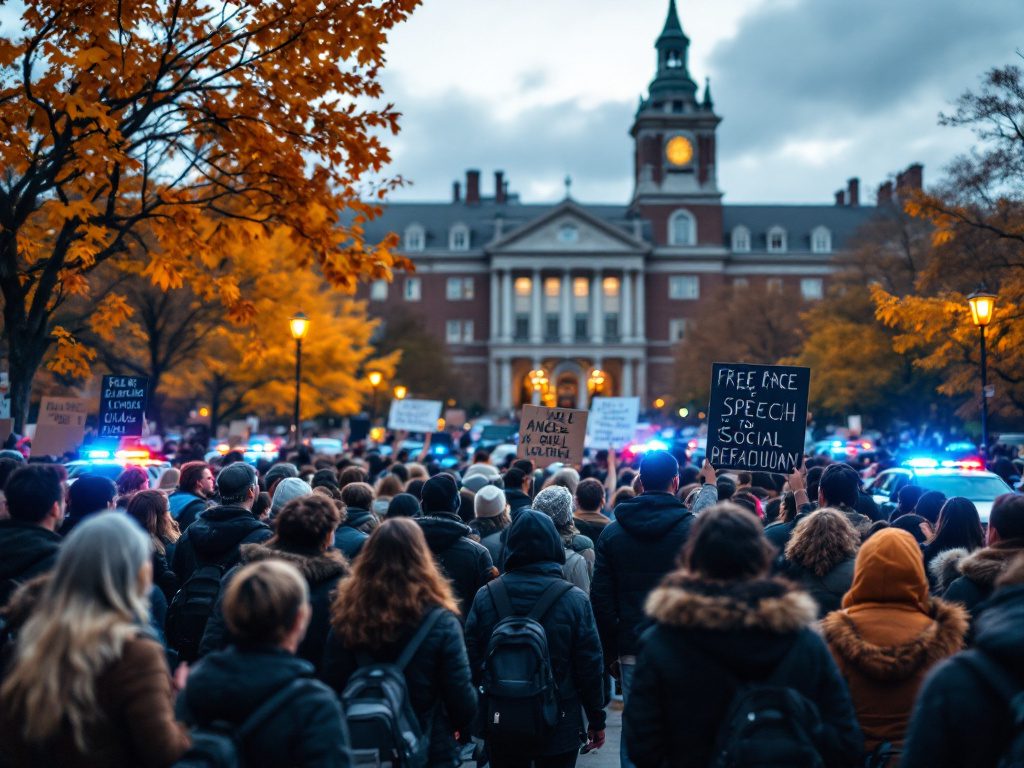
The Morning the Doors Came Down
Just after sunrise on April 23, residents of Ann Arbor, Ypsilanti, and Canton, Michigan awoke to the shocking sight of law enforcement officers in unmarked vehicles, storming several homes tied to University of Michigan’s pro-Palestinian activism. Flashing vests labeled “FBI” and the presence of Michigan State Police signaled that this was no routine knock at the door. According to the TAHRIR Coalition, advocacy group members and student activists were confronted by agents who swept through living rooms, confiscated laptops and cell phones, and led at least a handful out in handcuffs to waiting porches.
“They said the cuffs were for safety,” one student reported, but witnesses say the optics sent a much louder message: protest, and you may find your home invaded next. In Ypsilanti, law enforcement detained four individuals for about fifteen minutes before releasing them; in Canton, a home was searched, but no one taken into custody. Across the board, though, personal belongings vanished into evidence bags, including electronics essential to student life and organizing.
Any official rationale remains shrouded in silence. The FBI has refused comment, citing ongoing investigations. Yet, the timing is impossible to ignore: these raids follow months of heated protests, campus encampments, accusations of vandalism, and mounting pressure from both university leadership and elected officials grappling with the fallout of the Israel-Hamas conflict that erupted in October 2023.
Political Backdrop: Free Speech or Intimidation?
Peeling back the curtain, the deeper battle is not only about geopolitics—it’s about the right to dissent in America. The TAHRIR Coalition, a pro-Palestinian group with a sizable footprint at the University of Michigan, claims these raids are retribution for their calls to divest from Israeli interests and their visible protests on campus. State Attorney General Dana Nessel’s office has not confirmed the group’s suspicions—yet her record has prompted skepticism from progressives and civil libertarians.
Nessel, Michigan’s first Jewish Attorney General, was recently booed by Palestinian supporters at the Michigan Democratic Party Convention after backing prosecutions of protesters involved in campus encampments. Civil rights attorneys, including those at the American Civil Liberties Union of Michigan, are sounding alarms about the dangerous precedent set by using criminal law enforcement—not university disciplinary systems—to police peaceful protest. “The fundamental question,” notes University of Michigan Law Professor Leah Litman, “is whether political activity is being singled out and punished not for law-breaking, but for expressing the ‘wrong’ opinions.”
Is this really about enforcing the law, or are authorities leveraging their immense power to silence a movement that has become uncomfortable for those in power? The echoes of previous crackdowns—from the suppression of anti-war demonstrations during the Vietnam era to the surveillance and harassment of civil rights leaders—hang heavy in the air. As historian Taylor Branch once wrote, “When the state decides who can protest and what they can say, democracy itself stands trial.” Free speech has never been a blank check, but when law enforcement is deployed against non-violent activists, the message from the state feels unmistakably chilling.
“To have your door smashed in at dawn is not only a violation of privacy, but a warning shot meant to scare a whole generation into silence.”
Beyond that, experts warn that such tactics often backfire. According to a 2022 Pew Research study, public confidence in the impartiality of law enforcement plummets in the wake of perceived political targeting, especially among younger and minority populations. At a time when universities are struggling to balance competing demands—insisting on campus safety while honoring First Amendment rights—the cost of eroding trust may last far longer than the news cycle.
The Case for Protecting Dissent
A closer look reveals the raids were not isolated events, but part of a larger pattern of heavy-handed responses to the nationwide upsurge in student activism over the past year. From Columbia to UCLA, crackdowns have ranged from mass arrests to threats of expulsion—and Michigan’s show of force fits into a disturbing trend in which authorities treat organizing itself as an implicit threat. But as historian Carol Anderson argues, the right to protest is “the oxygen of democracy,” not a privilege doled out by bureaucrats or politicians.
If the United States is to remain a beacon for free thought, then students advocating for Palestinian rights—however contentious their message—deserve the same civic protections that shielded anti-apartheid activists in the 1980s or Vietnam War protesters a generation prior. Heavy-handed police action fueled opposition back then, growing movements rather than crushing them. According to University of Michigan sociologist Nadia Fadil, “There’s a direct relationship between state repression and the resilience of protest. The more forceful the tactics, the more they galvanize new support and drive the narrative underground.”
What future does this foreshadow for those bold enough to challenge the status quo? Even measured voices within the Michigan political establishment—such as State Representative Abraham Aiyash—have called for restraint and transparency, warning that the crackle of boots on porches will not usher in compliance, but deepen the gulf between officials and the citizens they serve. For readers who recall the power—and peril—of the 1960s protest movements, today’s headline invites an uncomfortable déjà vu. Are we willing to repeat history’s mistakes or learn from them?
Toward a More Just Path
There’s no minimizing the tension and anger on campuses across Michigan. Vandalism, intimidation, and genuine hate speech have no place in civil discourse—nor should they be conflated with constitutionally-protected protest demanding oversight of foreign policy, human rights, or institutional investments. As Harvard law professor Jeannie Suk Gersen argues, “Responding to campus unrest with force is not just a legal overreach, but a moral failure—a retreat from the ideals we claim to cherish.”
To reclaim the promise of American higher education, institutions and law enforcement should prioritize dialogue, transparency, and proportional responses to real threats—not blanket crackdowns on dissent. The solution lies not in show-of-force raids, but in renewed commitment to democratic norms that protect the right to be heard—even, and especially, when the message is uncomfortable.
