
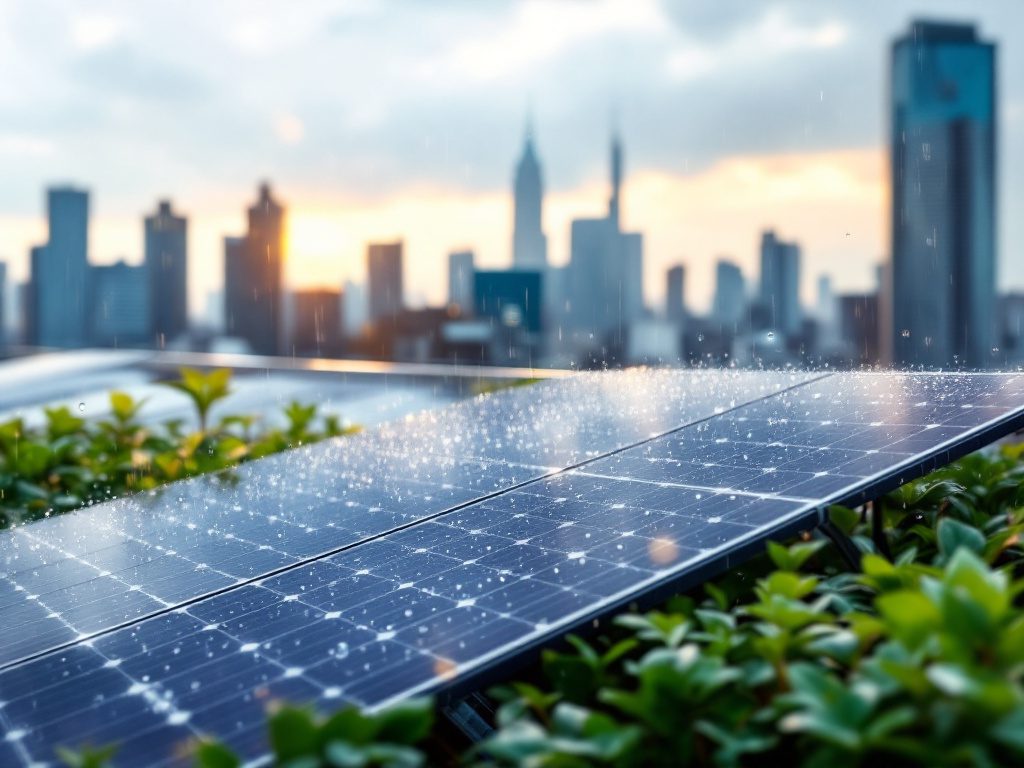
When Rain Becomes Power: A Spark of Innovation
Picture this: a city rooftop on a rainy day. Instead of the usual dull drumming, each raindrop quietly powers a constellation of LED lights inside. This isn’t science fiction. Thanks to researchers at the National University of Singapore, harnessing the energy of falling rain is on the brink of becoming real-world science—potentially poised to transform the way we think about renewable energy in our daily lives.
At the heart of this revelation lies a deceptively simple experimental setup: a slender, 32-centimeter tube with a 2-millimeter-wide interior. As water droplets cascade down this tiny channel, a phenomenon known as “plug flow”—a train of discrete water columns separated by air—occurs, turbocharging the separation and harvesting of electrical charges. Amazingly, this minuscule innovation achieved more than 10 percent efficiency in converting mechanical energy from falling water into electricity. That’s not just a step up; it’s a profound leap, outperforming legacy methods by five orders of magnitude at a similar scale.
Why does this matter? American rooftops alone span billions of square feet. For decades, we’ve thought of capturing sunlight and wind; now, the vision expands. Raindrops—a force as old as time—may light our kitchens and power our devices.
Rainy City, Bright Future: How Plug Flow Upends Old Assumptions
Previous efforts to exploit rain’s energy floundered on the shoals of physics. Micro- and nano-channel devices created higher voltage in theory, but water is stubborn; it refuses to flow naturally through such tiny spaces, and artificial pumping eats up more energy than is gained. This is where plug flow in a modest tube sidesteps the old dilemmas. Instead of brute-forcing smallness, it welcomes a physical sweet spot—water columns effortlessly sliding down, charge separating on the fly, and every drop doing double duty.
Look back at the evolution of hydroelectricity: the Hoover Dam, an icon of American ambition, requires vast rivers and monumental engineering. Critics often point to such projects’ environmental toll, from damaged ecosystems to displaced communities. “Our new method can be set up nearly anywhere with rainfall and gravity,” explains Dr. Xuewei Zhang, lead author of the Singapore study, in an interview with ACS Central Science. “It’s simple, modular, and low-cost.” In other words, a far cry from the heavy footprint and political gridlock of big hydro.
Urban dwellers may see the most benefit. While wind and solar dominate headlines, many cityscapes lack wide-open spaces or consistent breezes, and tall, densely packed buildings produce tricky wind patterns that leave turbines underperforming. The notion of transforming every rooftop in rainy Portland or New York into a mini power plant is tantalizing. Imagine emergency lighting, communications relays, or battery charging—all powered by the weather’s own rhythm.
Harvard environmental engineer Dr. Shira Goldsmith contextualizes the breakthrough: “This sort of distributed, hyper-local generation could close glaring gaps in resilience—especially during grid failures from climate-linked storms. Anyone who remembers Superstorm Sandy’s blackouts knows how urgent that is.”
Clean Power for All? Navigating Challenges and Inequities
Of course, while the science is promising, equity and policy questions loom large. Who will gain access first: wealthy homeowners with solar panels already dotting their rooftops, or renters in aging buildings? As with solar and wind rollout, there’s a risk the benefits might flow unequally through society if progressives do not push for inclusive infrastructure mandates and public investment.
“Raindrop energy isn’t just a novelty. With purposeful policy support, it can give urban and rural communities alike a new stake in the clean energy transition. We need innovation, yes, but also the political will to ensure everyone shares the benefits.”
— Dr. Shira Goldsmith, Harvard School of Engineering
Liberals who champion climate and social justice would be amiss to overlook the importance of scalable support. Rain-based energy may not single-handedly displace coal or gas, but it offers a crucial piece in the mosaic of decentralized, democratized power. According to data from the Pew Research Center, 75% of Americans now favor increased federal investment in renewable technologies. Familiarizing the public with every facet of clean generation—including rain—is key to broadening that consensus and fighting back against fossil fuel interests still lobbying to slow the transition.
A closer look reveals another compelling angle: resilience. In regions battered by severe storms or erratic weather brought on by climate change, every little backup counts. Plug-flow systems need only gravity and rainfall—no sunlight, no big turbines, no moving parts prone to failure. Communities off the main grid or recovering from disaster could leapfrog traditional utility models, lighting up dark nights drop by drop.
Policymakers, urban planners, and climate activists face a rare opportunity. They must ensure that research funding, pilot installations, and technical training reach not just affluent areas, but also schools, apartment buildings, and storm-prone neighborhoods. Diversity in technology ensures resilience—and hope—in the face of both political inertia and planetary peril.
The Next Drop: Building a Future Where Rain Lights Up Our Lives
Bringing it full circle, the story of raindrop energy is one of both optimism and unfinished business. Breakthroughs like this challenge us to rethink scarcity and embrace abundance; to turn even the most commonplace natural phenomenon—rain—into a shared asset. As policies lag and vested interests do their best to muddy the waters, it falls to progressives, innovators, and everyday citizens to raise their voices and insist this technology doesn’t gather dust alongside so many other lost climate solutions.
What could be more democratic than a power source that falls from the sky on rich and poor alike? If researchers, policymakers, and community leaders seize the moment, future generations may look back and wonder: why did it take us so long to see the potential in something as simple as a drop of rain?
