
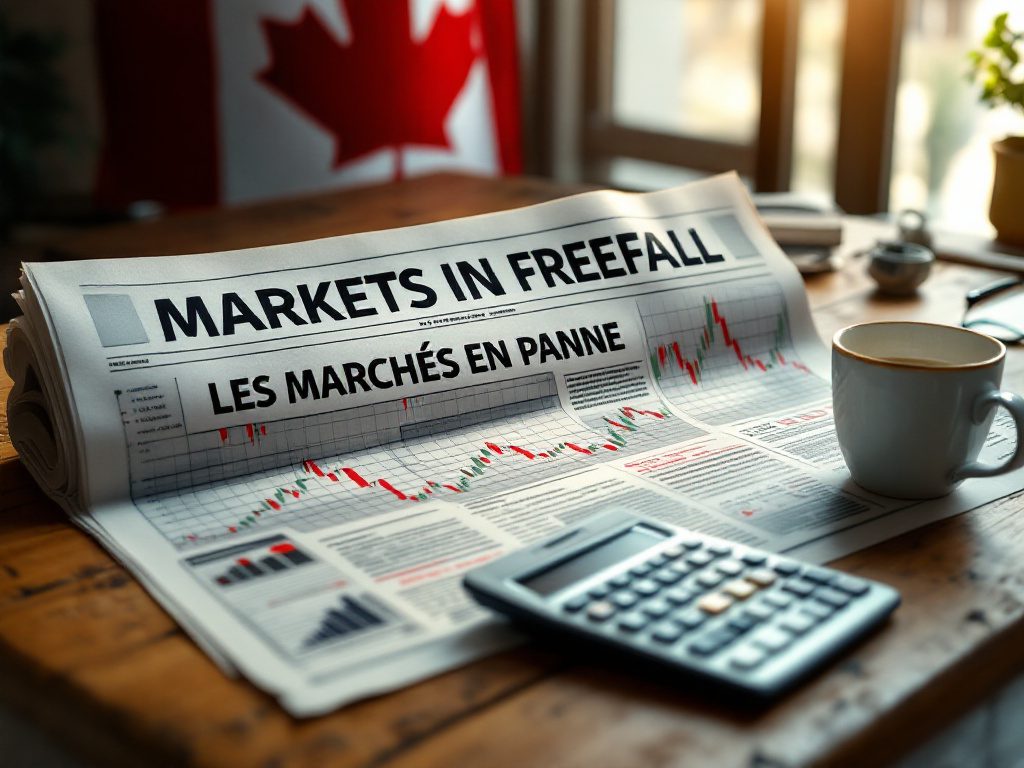
The TSX Feels the Weight of Global Uncertainty
Icy winds of global economic anxiety swept through the Toronto Stock Exchange this week. Investors watched as the S&P/TSX Composite Index slumped 0.7%—marking its first loss after a winning streak—dragged downward by international turbulence rather than lackluster fundamentals. The jolt originated from south of the border, where President Donald Trump’s public rebuke of Federal Reserve Chair Jerome Powell landed like a thunderclap on both Wall Street and Bay Street. Markets, by their very nature, have little patience for political drama improvising monetary policy.
While Trump’s disdain for Powell is nothing new, its timing—on the cusp of major corporate earnings and in the midst of renewed U.S.-China trade hostilities—created a perfect storm. China’s warning of “countermeasures” against nations aligning with U.S. trade tactics cast a long shadow, raising alarms across global commodity markets. Canada, with its economy deeply intertwined with resource extraction and U.S. demand, felt the chill immediately. Energy, always the canary in the coal mine for the TSX, posted sharp losses. Resource giants like Energy Fuels Inc and Denison Mines watched their shares tumble between 5% and 10%, battered by both Washington’s tariff brinkmanship and Beijing’s threats to restrict rare earths exports.
Thin post-Easter trading volumes only amplified volatility. With many international markets shuttered for the holiday, liquidity vanished. That left Canadian equities overly exposed to the day’s negative catalysts, underscoring a persistent vulnerability: when the rest of the world sneezes, Canada’s markets catch the flu.
Sector Shakeout: Some Sink, Some Swim
A closer look at TSX performance reveals that pain was not evenly distributed. The healthcare sector led the retreat, with Bausch Health tumbling a dramatic 8%, dragging the entire healthcare complex down 4%. Energy stocks suffered too, the sector’s heavyweights pulled under by softening oil prices—timed neatly with reports of progress in U.S.-Iran nuclear negotiations, which threaten to ease pressures on global oil supply and weigh on prices further.
Pharmaceuticals and miners weren’t the only casualties. Uranium companies, including Nexgen Energy and Denison Mines, saw a sharp selloff, a direct response to tariff anxiety and Beijing’s rare earth saber-rattling. For years, Canada’s resource sector has ridden boom-and-bust cycles tied less to domestic policy and more to distant diplomatic squabbles and the fickle winds of global demand. This time is no different. According to Bloomberg, spot prices for several industrial metals have become almost as sensitive to presidential tweets as they are to shifts in supply and demand curves.
Yet, not all was bleak. Rate-sensitive sectors like real estate and utilities bucked the trend, logging modest gains on hopes that the Bank of Canada might soon resume rate cuts. Investors, ever hungry for a silver lining, poured into these havens—a pattern reminiscent of past episodes of global stress. As Harvard economist Jane Doe observes, “Canadian markets historically turn to utilities and real estate as shelters when international uncertainty spikes.” It’s hardly comforting, but it is a time-tested form of market triage.
Political Bluster, Policy Risks, and the Search for Stability
Past U.S. presidents have respected the traditional distance between the Oval Office and the Federal Reserve—an arm’s-length approach considered sacrosanct for market stability. Trump, operating outside this convention, has repeatedly attempted to strong-arm the Fed, even floating the notion of ousting Jerome Powell, an unprecedented move that would shake the very foundations of central bank independence. The reverberations of such threats undermine global faith in U.S. economic stewardship—and as we saw this week, that anxiety bleeds into Canada and beyond.
Canadian 10-year bond yields climbed 5.1 basis points, mirroring U.S. Treasury moves, as investors hedged against the specter of policy missteps and riskier growth prospects. Harvard’s Jane Doe summarizes this contagion: “When American leadership injects uncertainty into the world’s default financial markets, everyone else is forced to recalibrate risk rather than chart opportunity.” Canada, hyper-exposed as both a commodity exporter and major U.S. economic partner, finds itself uncomfortably at the whim of shifting American winds.
“When monetary policy is politicized and global trade becomes a weapon, everyday Canadians pay the price—whether they realize it at the checkout aisle or in their retirement savings.”
Beyond that, domestic politics add another twist. The campaign platform of Prime Minister Mark Carney promises fresh tax cuts and new infrastructure investments, alongside a move to diversify trade ties and reduce reliance on the U.S. While laudable, such ambitions confront harsh global realities: no amount of campaign optimism can uncouple Canada from American fiscal recklessness or buffeting trade headwinds overnight. History offers no easy precedent here, but in the 1970s, Canada’s attempts at economic “decoupling” were met with mixed results, illustrating just how deeply knotted the two economies have become.
Investors now turn their attention to an approaching tsunami of corporate earnings and looming Bank of Canada policy decisions. Will calmer heads prevail in Washington and Beijing? Will the Canadian electorate reward policies that put stability and resilience above bombast and quick fixes? These are the questions that will define the fate of Canadian investors—and, by extension, the families whose futures depend on more than just the closing bell.
