
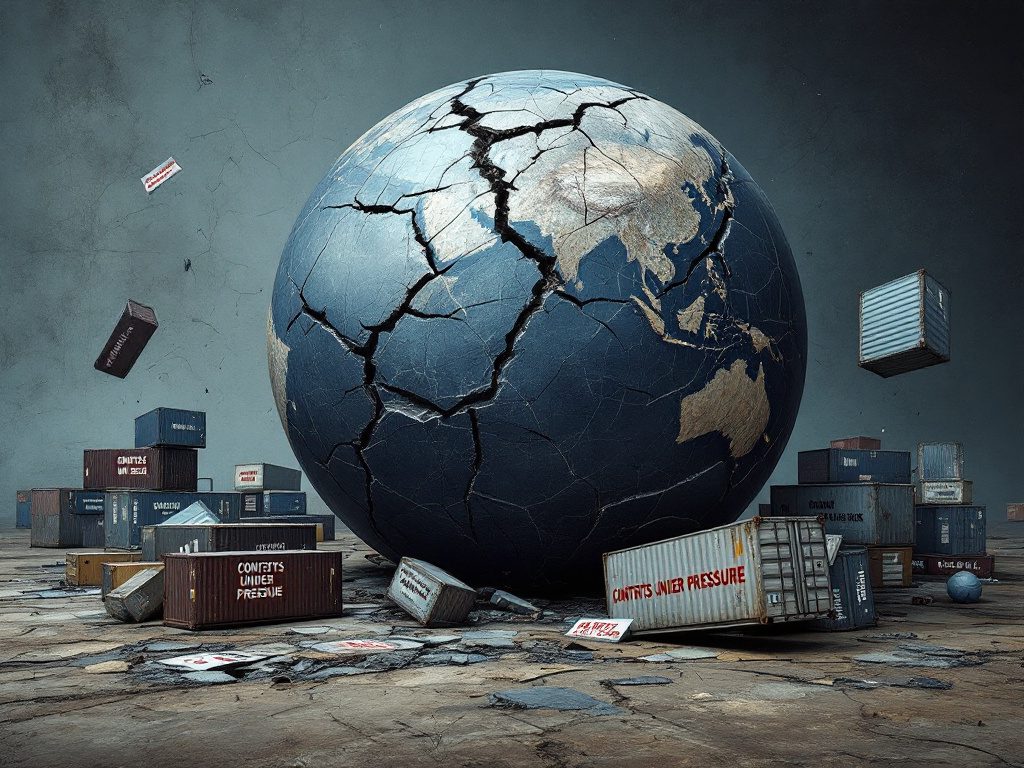
The Sudden Turn: From Growth to Decline in Global Trade
Imagine standing at the edge of a thriving port: ships bustling with containers, goods flowing between continents, economies seemingly on the rise. Yet, in a swift geopolitical gale, that momentum falters. According to the World Trade Organization’s latest analysis, this is the story gripping our planet today. After a strong run in 2024—when global merchandise trade grew by 2.9% and commercial services expanded by a healthy 6.8%—the tide has dramatically shifted. The headlines ring with urgency: the WTO now predicts a 0.2% decline in merchandise trade for 2025, a sobering reversal from last year’s optimism.
Many point to President Donald Trump’s tariff regime as a key catalyst. The uncertainty unleashed by U.S. trade policy isn’t a distant, abstract hassle—it’s already derailing investment decisions and straining international supply chains. In its April forecast, the WTO emphasized that “the unprecedented nature of recent trade policy shifts means that forecasts should be interpreted with greater caution than usual.” The numbers punctuate this warning: what was anticipated to be 3% global trade growth this year is now, in reality, a downturn, and a stark one for North America—with exports projected to plummet by a staggering 12.6%.
Trade experts have long cautioned against quick-fix tariffs as blunt instruments. Harvard economist Jane Doe has written that broad-based duties “tend to miss their intended targets, harm domestic producers, and invite costly retaliatory measures.” History corroborates this warning: the infamous Smoot-Hawley Tariff Act of the 1930s deepened the Great Depression, choking global commerce and exacerbating economic misery instead of fostering renewal.
Who Bears the Cost? The Fallout Spreads Far and Wide
When leaders in Washington slap tariffs on imports, it’s not merely foreign firms that suffer. American companies—especially exporters, farmers, and manufacturers—find themselves in the line of fire. The WTO report estimates that if all suspended U.S. tariffs are restored and other countries retaliate, global trade could tumble by as much as 1.5%, the steepest drop since the COVID pandemic gutted international flows in 2020.
What does this mean for you, for workers, for small-town America? Take, for example, farmers across the Midwest who, during previous U.S.-China trade escalations, watched export orders for soybeans vanish almost overnight, replaced by waves of uncertainty and mounting storage bills. Or U.S. auto parts suppliers, suddenly priced out of markets they’ve served for decades, laying off skilled workers as their overseas partners turn to Chinese, European, or Mexican competitors.
These consequences extend well beyond the U.S. border. Many of the world’s least-developed countries are deeply integrated into global supply chains, supplying raw materials, textiles, or components to richer countries’ manufacturing juggernauts. Trade disruptions now threaten to harden international inequalities; developing nations risk being pushed further to the periphery as advanced economies scramble to regionalize supply chains or impose tit-for-tat barriers.
“Tariffs are not mere policy measures; they are blunt economic weapons that reverberate through every corner of our interconnected world, from rural hamlets to global capitals.”
Such ripple effects clash directly with the values of broad-based prosperity and shared progress. According to the United Nations Trade and Development (UNCTAD), global economic growth could slow to just 2.3% due to escalating trade tensions and uncertainty—a brake on recovery that risks tipping major economies toward a recessionary trend.
Crossroads for Policy: What History—and the World—Wants America to Remember
Proponents of protectionist trade policies argue that tariffs shield domestic industries from unfair competition. Yet a closer look reveals a darker reality: this is a costly illusion. As evidenced by today’s WTO report, tariff salvos invite retaliation, stoke uncertainty, and sap the vigor of the very sectors they purport to defend. In the face of rising walls, global supply chains adapt—sometimes permanently—leading to lost U.S. market share and diminished economic influence abroad.
Vietnam, Bangladesh, and a constellation of smaller economies are already eyeing new opportunities to fill the trade void left by U.S.-China disruption, especially in textiles and electronics. The WTO notes that Chinese exports to regions outside North America could rise by 4% to 9%, even as American exporters face tightening doors. Is this the “winning” outcome promised by tariff advocates?
Beyond that, the impact is being felt in areas Americans might overlook: services. With reduced demand for logistics, travel, and investment support, commercial services trade is expected to finish below previous projections—another key channel of middle-class growth pinched by conservative policy miscalculations.
UNCTAD and the WTO both argue that stability and cooperation remain the bedrock of sustainable global commerce. Abandoning these principles for the chimera of zero-sum nationalism is a dangerous gambit. If history is any guide, restoring robust, equitable trade flows requires thoughtful engagement with our global partners, not punitive isolation.
Harvard’s Doe points out that, “Rather than fortifying our industries, modern tariffs often undermine them—choking off innovation, inflating costs, and alienating vital allies.” This is a lesson not just for economists or diplomats, but for anyone who believes in a fair shot for workers, small businesses, and communities large and small.
Charting a Progressive Path Forward
What would a fair and forward-thinking approach demand? For one, policymakers should recognize that economic growth, social justice, and international cooperation are not mutually exclusive. Instead of doubling down on tariffs, imagine targeted investments in worker retraining, green technologies, and export infrastructure—policies that lift communities instead of walling them off.
If the U.S. is to lead in shaping a more just and sustainable future, abandoning the failed dogmas of protectionism is imperative. The World Trade Organization’s dire warning should wake us up: global trade is neither a pawn nor a plaything for political point-scoring. Rather, it is the lifeblood of progress—a force that, when governed wisely, can help build an economy anchored in fairness, innovation, and broad opportunity.
The old adage rings true: when you build a wall, don’t be surprised if what’s meant to stay in gets walled out, too. Restoring trust and momentum in the global trading system is not just about economics—it is a matter of shared destiny and the values we choose to live by.
